
Bunker vs Verity Enemies Guide
Spot Verities in Bunker vs Verity and read their verified attack behaviors, from entrance rushes to late-wave variants, before choosing your defenses.
Everything that charges your bunker in Bunker vs Verity is a Verity — that is the enemy's official name. The game's own listing tells you to "Fight off endless waves of Verities" and warns: "The longer you survive, the harder the Verities become." In practice that means creatures arriving in groups from several directions, singling out your weakest walls and entrances, and mixing fast rushers with tough wall-breakers that shrug off weak turret fire. Read below to recognize them, understand what each behavior means for your base, and pick defenses that answer what you actually see.
What a Verity is
Guides define Verities as "the collective name for the hostile entities that emerge in waves and attempt to breach your bunker." Up to six players dig in, build walls, place turrets, and hold out while each wave approaches the base from multiple directions, chews on walls, and forces the team to balance shooting, repairing, and upgrading. Two more facts shape every fight:
- Kills pay. Every Verity you kill drops money, which funds turrets, blocks, and upgrades between waves.
- They come for you, not just the base. Verities attack players directly, and sessions show them swarming an exposed player fast.
One caveat on timing: written guides describe a day–night rhythm — build and upgrade by day, defend at night — while recorded sessions show players starting raids manually, sometimes choosing their starting wave. Don't anchor your routine to a fixed clock. Treat the start of each wave as the moment everything outside your walls becomes a threat.
How to recognize a Verity
Don't expect the game to label them for you — no available footage or guide confirms on-screen name tags for enemies, so identification works by shape and behavior:
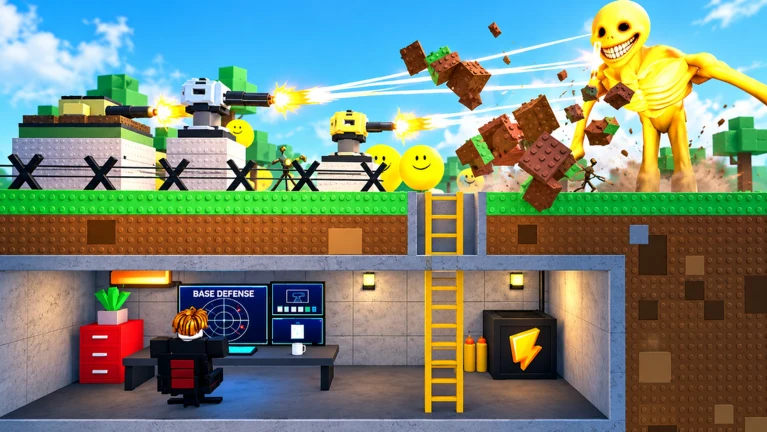
- Early waves: small, round, ball-shaped creatures, some of them green. They die fast alone but arrive in packs.
- As waves climb: the mix gets faster, denser, and tougher, with larger shapes appearing — including giants in late sessions.
Confirmed attack behaviors
Multiple guides converge on the same behavior families, all observable without any stat sheet. Build your read of a wave around these four:
| Behavior | What it looks like in a wave | How defenders answer it |
|---|---|---|
| Entrance rushes | Fast approach speed; weak individually, dangerous in packs; first contact at your doors | Fast-attack early defenses and a monitored entrance |
| Durable wall-chewers | High structural damage; absorb sustained turret fire while grinding through walls | Single-target damage turrets on a clear firing lane |
| Grouped pushes | Several Verities reach the bunker on one lane at the same time, overwhelming isolated defenses | Crowd-control placement at chokepoints and crossfire layouts |
| Weak-spot targeting | Attacks concentrate on the most exposed sections: entrances and doorways, damaged or thin walls, isolated defenses | Reinforce frequently hit sections first; never leave one lone turret covering a lane |
Waves escalate along a consistent curve: early waves are small groups of low-durability creatures trickling toward the entrance, while late waves are dense groups of durable units that trigger breach cascades on any weak section. The lull between waves is its own hazard — complacency. Use it to inspect, repair, and reassign before the next wave forms.
What late waves have been caught doing
Gameplay footage adds behaviors that only show up once waves get serious. One creator watched Verities break in through his wall — "you guys can see the sand falling through" — and later found them already inside the bunker, with no idea where they had entered until he tracked down the breach point. In an Indonesian-language session around waves 17–18, Verities dug down and overran the player's underground room entirely. Two practical takeaways: your underground base is not automatically safe, and a breach can open anywhere your structure is thin.
Later sessions show more variety, described by players in the moment rather than by the game: Verities that explode ("they can blow things up"), bomb carriers, ninja-like fast movers, enemies arriving with shields and shooting back around waves 16–17, and a bomb-carrying Verity chasing a player around the map at very high waves. Around wave 10 in two separate sessions, a much larger Verity appeared, soaked up sustained fire, and tore turrets down; in one session, defeating a large Verity paid out 5,000 coins — a single-session observation, not a confirmed payout rule. A German-language guide describes the same shape of threat as the "giant scary Verity": large, highly resistant, concentrating attacks on single wall sections as wave pressure rises, and punishing weak entrances and blocked firing lines.
None of those nicknames are official. They come from creators' commentary — much of it auto-transcribed from other languages — and descriptive guide titles. They are useful for describing what to watch for, not for what the game calls anything.
What is and isn't confirmed in the name
Only one name is official: Verity. Because the game is a newer release, official enemy names and stat values are still being documented, and public game data has not confirmed an official in-game "Boss" category. Until the developer publishes a formal enemy classification, the honest way to think about the enemy force is: every attacker is a Verity, and you rank what's coming at you by observed behavior and threat, not by title. Labels like swarm, bruiser, fast mover, or breacher are tactical shorthand guides use for the behaviors in the table above — no HP values, damage numbers, or elemental types have been documented for any Verity, so treat any source quoting exact stats with suspicion.
Choose defenses against behaviors, not names
Since there is no confirmed roster to build against, match your setup to the patterns you can see:
- Groups pushing one lane → crowd-control turret near a chokepoint
- Durable targets hammering a wall → high single-target damage on a clear approach lane
- Fast rushers heading for the door → fast-attack early defense with clear sightlines
- Breachers and weak-spot attacks → reinforced walls plus a layered fallback position
- Between every wave → reinforce and repair the sections that got hit, immediately
Your turret placement decides whether those counters have clear lanes, and the defense strategy page covers how the pieces fit together as waves scale. Next time a wave forms, watch where it goes rather than what anyone calls it — Verities announce their attack plan by the lane they pick and the wall they hit.
Related Guides
Turrets Guide
Every turret confirmed in gameplay — shotgun, gatling, Halo and variants — and which job each one does best.
Turret Placement
Place turrets where they actually defend: cover the main approach, overlap firing arcs, and keep every lane covered.
Wave Difficulty
See what actually changes each wave as Verities grow tougher, and why no official thresholds or final wave exist.