
How Waves Work in Bunker vs Verity
Bunker vs Verity waves are endless: prepare by day, defeat numbered night waves, use the break to repair and upgrade, and measure your run in waves survived.
Bunker vs Verity has no final wave to beat. The official game description promises endless waves of Verities and asks you exactly one question: see how many waves you can survive! Players have pushed single raids past wave 90, so the thing to understand is the loop itself — prepare by day, survive the numbered wave that arrives, use the break to rebuild, and face a harder attack next time.
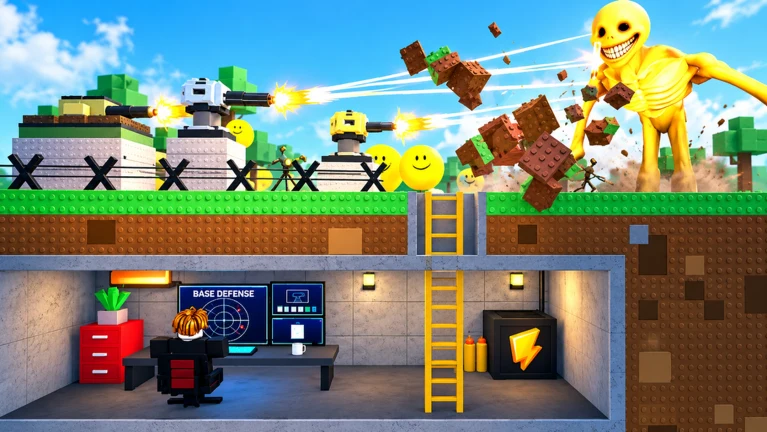
The wave loop: prepare, defend, recover
Day: build and earn. The game runs on a day-and-night rhythm. Daylight is your construction window — fortify the bunker with blocks, place and control turrets, and manage coins for upgrades. Before dark, run a quick inspection: check firing angles, clear movement paths, make sure no turret's coverage is blocked, and get everyone into position near the defensive zone before the Verities spawn.
Night: the wave. Verities — the collective name for the hostile entities that attack your bunker — arrive in numbered waves that push hardest at your walls, entrances, and exposed firing positions. A wave is not one enemy repeated: faster Verities rush entrances, durable ones soak turret fire, and grouped pushes can arrive from several lanes at once.
Between waves: the lull. When a wave's last Verity falls, you get a break. This is the intended slot for inspecting damage, repairing walls, buying upgrades, and reassigning roles — guides single out complacency as the main way this window is wasted. The break is finite and its exact length isn't documented, so use it immediately. The next wave is always stronger than the last: the longer you survive, the harder the Verities become.
How waves start and stop. In gameplay, the attack runs as a raid. Starting a raid begins the wave — one player starts at wave 1 after his first building phase, and in a later session starts a new raid directly at wave 25. While a raid is active, building is locked. Ending the raid brings building and weapon purchases back, and you can start a raid again afterwards; creators are shown ending raids after hitting a goal wave or as night falls, then immediately starting the next one. Guides describe waves simply as automatic night attacks, and no source spells out how that rhythm and the manual raid controls fit together. The observable constant either way: waves arrive in rising numbered order, building locks while a wave is active, and the raid controls are how you stop and restart the defense.
What the screen shows during a wave
Survival progress is readable at a glance. The current wave number is displayed during play — creators narrate it at wave 1, 8, 10, 23, 90, and 91 across different runs. Within a wave, you can track the enemies left, counting them down ("two Veritys left") as each kill pays coins; cleared waves get called out in turn (wave one done; wave level 4 clear; wave 9 done as wave 10 arrives).
| On-screen information | What it tells you |
|---|---|
| Current wave number | Which attack you're on — it starts at wave 1 and rises as waves are cleared |
| Enemies remaining | Progress within the wave; when the last Verity falls, the wave is survived |
| Coins on each kill | Defeated Verities pay coins — your income while defending, spent in the break |
| Boss or mini-boss arrivals | Heavier waves show up at higher numbers, but on no confirmed schedule |
| Top wave / top kills / top coins stats | Display values read in one video (top wave 700); personal records or leaderboard is unconfirmed |
Two of those need caution. Bosses and mini-bosses appear in footage — one run meets a mini-boss around waves 4–5, others meet big bosses at waves 10, 15, and 20 — but the reports don't line up into a fixed schedule, so don't plan around one. And the top wave / kills / coins figures are just that: figures on a screen whose nature is unconfirmed, not proof of a cap or a ranking. How much harder each step gets is its own topic — see wave difficulty.
What counts as surviving a wave
A wave is survived by defeating every Verity in it. Survive, keep the coins your kills paid, spend the break, and the counter steps up to a stronger wave. Across a run, progress is expressed as the highest wave reached — creators compare results exactly that way: one's best was wave 8, another's wave 10, a third's wave 7, and one surrendered at wave 26.
A run ends where your defense does — Verities break in somewhere, and once you can no longer survive, that's the run. Don't count on a payout per wave, either: the only wave-related reward visible in gameplay is a one-time 5,000-coin drop after the wave-10 boss in a single run. No source shows a reward granted after every wave.
What isn't confirmed about waves
- No final wave is documented. A run carried past wave 90 (with wave 91 read live) fits the official endless framing, and the 700 "top wave" figure is a stat value, not a cap.
- No per-wave reward rule exists in any source. Plan your economy around per-kill coins and the between-wave break, not an expected wave-completion payout.
- The stats display can't be pinned down. Until it's clear whether top wave / kills / coins are personal bests or a server leaderboard, treat them as display values rather than a ranking.
Once the loop is clear, the rest is execution: how to survive more waves and defense strategy pick up the surviving side, and new players can start from the beginner guide.
Related Guides
Wave Difficulty
See what actually changes each wave as Verities grow tougher, and why no official thresholds or final wave exist.
Verity Enemies Guide
Identify each Verity type and its confirmed attack behavior, then match defenses to rushes, diggers, and late variants.
Survive More Waves
Fix the habits that end deep runs: one-entrance builds, coin discipline, between-wave inspections, and targeted upgrades.
Defense Strategy
Run the day-to-night defense cycle: overlapping turret coverage, repairs under fire, and coin spending by wave phase.