
Bunker vs Verity Wave Difficulty Explained
How wave difficulty works in Bunker vs Verity: the official harder-over-time rule, what actually changes each wave, and why no multipliers, thresholds or final wave are published.
Bunker vs Verity has one official difficulty rule, and the game's own description states it plainly: "The longer you survive, the harder the Verities become." The same description frames the axis that rule runs on — you "Fight off endless waves of Verities" and "See how many waves you can survive!" — so it is survival time itself, wave after wave, that drives the pressure up. Below is what that actually looks like: which characteristics change as waves advance, what supports those observations, and what the game has never published (any formula, threshold or final wave). This page focuses on those changing characteristics; the full wave loop and its counting UI are covered in the waves guide.
The official rule: pressure follows survival time
That one sentence is the complete official statement of difficulty scaling. It promises a direction — harder over time — but stays deliberately qualitative: no numbers, no curve, no cap. The identical description text appears on the game's Roblox store page and on third-party listing sites, so it is the current official copy rather than an outdated line. Everything else known about scaling comes from observation: written guide profiles of early, middle and late waves, plus footage from recorded runs with on-screen wave counters.
What changes as the waves go on
Three characteristics account for most of the added pressure:
- Durability. Enemies shift from weak early-wave swarmers to durable late-wave bruisers that "concentrate attacks on your weakest wall sections." Guides summarize the direction as monsters growing "tougher, more numerous, and far more capable of tearing through an underprepared bunker."
- Numbers and grouping. "Verity durability and group size increase" — mid waves arrive in clusters that punish isolated defenses. That is why one well-placed turret handles the early waves but stops being sufficient later: coverage has to split between crowd control for swarms and single-target damage for tough individuals. Per-enemy behavior profiles are in the Verity enemies guide.
- New behavior. Later waves add Verities carrying weapons or shields, explosive and bomb Verities, diggers that bypass surface walls entirely (a direct threat to underground rooms), attacks from the sides and rear, and visibly faster movement.
Written guides pin these changes to wave stages:
| Wave stage | Documented threat profile | Matched response |
|---|---|---|
| Early waves | Low durability; test your entrance coverage; handled by a single well-placed turret | One well-placed turret on the approach |
| Middle waves | Arrive in clusters; punish isolated defenses; require overlapping fire and repairs | Overlapping fire plus repairs between waves |
| Late waves | High-durability threats that concentrate attacks on weak walls; demand focused fire and coin reserves | Focused single-target fire plus a reserve |
| Late-wave specials | Appear when defenses are worn down and target the weakest structural side | Reinforce and repair immediately |
These stage labels are strategy profiles written by guide authors — prescriptive preparation advice, not measured per-wave data — so treat the boundaries as approximate.
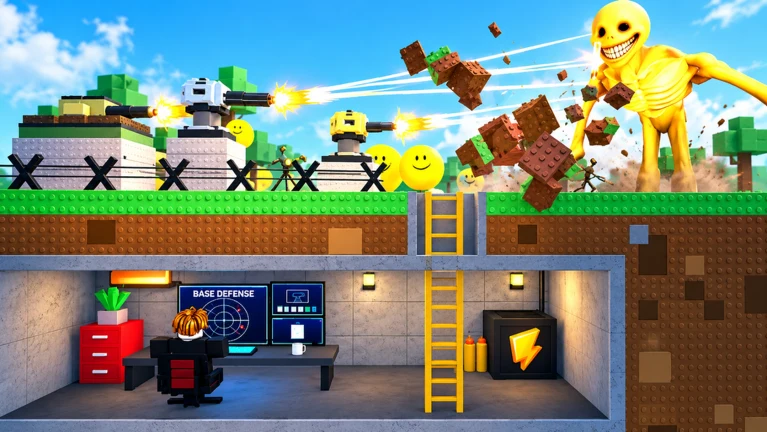
Recorded runs with visible wave counters add concrete examples:
| Narrated wave | Observed pressure change | Recorded run |
|---|---|---|
| Wave 10 | A very large Verity — the narrator calls it a boss — destroys several turrets; Verities move very fast; from wave 11 the narrator starts taking damage and waves feel noticeably harder | One narrated co-op session |
| Mid-run | Some Verities dig down toward underground rooms, bypassing surface walls entirely | Same co-op session |
| Wave 14 | Verities appear carrying weapons; a separate run reports enemies attacking from behind around this stage | Two narrated sessions |
| Waves 15–16 | Enemies with guns and shields; unusual fast "ninja-like" variants; attacks start coming from the sides, not just the front; 13 enemies attacking at once | Hungarian- and Indonesian-language sessions |
| Wave 18 | 24 or more Verities attacking simultaneously; explosive Verities blow up defenses | Hungarian-language session |
| Waves 25–91 | A "giant wave" of Verities opens wave 25; at wave 91 a bomb Verity actively chases the player among many attackers | English-language solo session |
Every wave number in that table is read off the counter in a single session of a single recorded run. Durability and group-size increases are backed by multiple written guides, but the speed increase and every specific wave number rest on this footage alone — useful as examples of the trend, not as verified breakpoints, and they may shift after patches.
Why no multiplier or final wave is documented
No source — official or community — publishes a scaling formula, per-wave multiplier, HP curve or difficulty threshold. The official copy is qualitative only, and a dedicated Verity guide explains why it avoids numbers: because Bunker vs Verity is a newer release, official enemy names and stat values are still being documented, so it reports observable behavior patterns instead of unverified stat tables. The same guide family notes that public data has not confirmed an official in-game "Boss" category — big late-wave Verities that narrators call "boss" or "mini boss" are best treated as general enemies ranked by observed threat, not official tiers. There is also no documented final wave: leaderboard "top wave" values seen in videos are player records, not a cap.
So any claim like "difficulty doubles every N waves" or a table of exact per-wave stats is inventing numbers the game does not publish. Since the single-run wave numbers above can move after patches, it is worth rechecking difficulty behavior after each update.
Preparing the bunker for a harder curve
- Build for the wave after next. Never judge your bunker by the early waves — they are a baseline, not the standard, because Verities grow stronger every night.
- Use the between-wave window. Reinforcing walls and upgrading turrets between waves is described as essential, not optional, precisely because pressure rises each wave.
- Enter hard waves with a coin reserve. Relying on income earned mid-attack is cited as one of the most common causes of late-run collapses; the coins guide covers building that buffer.
- Shift late spending to the fallback line. Once enemy durability scales up, put new spending into a reinforced fallback line and turret upgrades instead of repeatedly replacing early cheap sections — the defense upgrades guide has the details.
- Match turret roles to the curve. Fast-attack defenses earn their spot in the opening phase before income grows; crowd control pays off once waves hit multiple lanes at once; single-target damage earns its cost later against one durable Verity. Placement specifics are in the turret placement guide.
A quick way to put all of this into practice: compare two of your own waves. Watch an early wave and your latest one back to back, and note three things — which walls took the hits, how many enemies attacked at once, and whether any new behavior appeared (diggers, side or rear attacks, armed or explosive Verities). Then reinforce the side that actually got hit, add the turret role that was missing, and start the next session with a full reserve. That comparison, not a formula, is the reliable read on your difficulty curve — and the guide to surviving more waves covers what to do next.
Related Guides
Survive More Waves
Fix the habits that end deep runs: one-entrance builds, coin discipline, between-wave inspections, and targeted upgrades.
Verity Enemies Guide
Identify each Verity type and its confirmed attack behavior, then match defenses to rushes, diggers, and late variants.
Defense Upgrades
The documented upgrade route: repair first, spend between waves, and improve the firing positions already proving useful.